
This month, the signals couldn’t be louder. Anthropic’s top lawyer declared that AI will end the billable hour. Simmons & Simmons’ senior partner predicted some firms won’t survive the next two to three years. Big Law posted another record year (revenue up 13%, billing rates up 10%), while AI-native firms like Crosby raised $60 million to build a completely different kind of practice.
Meanwhile, the conversation at the AFJE Congress in Paris made one thing clear: in-house legal teams are no longer waiting for permission to lead on AI and strategy. They’re already there.
Here’s what matters this month, and what it means for how you source and deliver legal services.
Industry Moves
Anthropic’s General Counsel: AI will kill the billable hour
Legal Cheek · ABA White Collar Crime Institute
Jeffrey Bleich, General Counsel at Anthropic, told the ABA’s White Collar Crime Institute that AI is eliminating the routine work that made the billable hour profitable. His argument: the hourly model has created a structural misalignment between firm and client interests. Clients want efficient resolution; the billable hour rewards complexity.
Damon Hart, top lawyer at Liberty Mutual, reinforced the point: value now sits in strategy and results, not time logged. IBM’s General Counsel Anne Robinson said she’s open to firms proposing outcome-aligned fee models.
Zaven take: The rhetoric around alternative fees isn’t new. What’s new is that the buyers of legal services (GCs at Anthropic, IBM, Liberty Mutual) are now openly calling for change. When the demand side moves, the supply side has to follow.
Big Law’s record year: revenue up 13%, billing rates up 10%, for the third year running
Bloomberg Law · Global Legal Post
The top 200 US law firms posted another exceptional year. Revenue climbed roughly 13%, billing rates rose nearly 10%, and demand grew 3.5%. Middle-market M&A drove a Q4 surge. But expenses also jumped over 10%, fuelled by headcount growth, lateral hiring, and technology investment.
Wells Fargo’s Owen Burman called it “very much an investment year,” suggesting returns won’t materialise until 2027 or 2028.
Zaven take: Three consecutive years of ~10% billing rate increases. Clients are absorbing it, for now. But how much longer before GCs accelerate the shift to value-based pricing and AI-driven alternatives? The clock is ticking.
AI-native law firms and platforms raise big: Crosby ($60M), Lawhive ($60M), Harvey ($200M)
The funding wave in legal AI continued at pace. Crosby, which positions itself as a hybrid AI law firm, closed a $60 million Series B backed by Lux Capital, Index Ventures, and Sequoia. The company offers fixed-rate contract review completed in under an hour, a direct challenge to the traditional billable model.
Harvey, backed by OpenAI and Sequoia, raised $200 million at an $11 billion valuation. Its new “Spectre” agent operates autonomously within the company, monitoring activity and making decisions without human prompts. A preview of truly agentic legal AI.
Zaven take: Legal tech consolidation has begun in earnest. As Keith Porcaro of Duke Law wrote for Bloomberg Law, the risk is that super-platforms create the next monopoly rather than democratise the law. Firms should pay close attention to what legal tech vendors are doing with their data and workflows.
“Looking forward two or three years, we’ll just be doing work very, very differently. I suspect some firms won’t survive. This is all moving very fast.” – Julian Taylor, Senior Partner, Simmons & Simmons
Voices from the Market
Julian Taylor on AI agents, pricing, and the future of legal careers
Simmons & Simmons’ senior partner revealed that 90% of the firm’s fee earners now use AI regularly through Percy, the firm’s in-house tool. They’ve partnered with German legal AI company Flank to develop AI agents for specific tasks, starting with NDA review on a subscription model.
On pricing, Taylor acknowledged the shift is real: clients want to pay for the ten minutes a task actually takes, not the hours it used to require. On training, he flagged the emerging tension: if AI handles the drafting, how do junior lawyers build foundational skills? His career advice was blunt: embrace AI or watch your career disappear.
John B. Quinn on building a $2bn litigation powerhouse by doing one thing well
The co-founder of Quinn Emanuel explained how the firm grew from four lawyers scrambling for work in 1986 Los Angeles into the world’s largest litigation-only practice. The key: full-service firms wouldn’t litigate against major banks because their corporate partners needed those relationships. That created an unmet need, and Quinn Emanuel filled it.
Quinn’s take on what makes a great lawyer was refreshingly simple: judgement first (the ability to predict how a judge or jury will react), hard work second. On market consolidation, he was blunt: star partners now command north of $20 million a year, and the rich will keep getting richer. The firm has never had a business plan. Their strategy has always been to recruit the best lawyers and pursue good opportunities.
Aaron Muhly on the widening gap between what GCs want and what law firms deliver
CEE In-House Matters · Evelaw
Muhly, founder of Evelaw and a speaker at this year’s CEE General Counsel Summit, argues that most law firms are still over-explaining their expertise and under-exploring their clients’ needs. Clients assume competence. They’re judging pitches on whether the lawyer understands their business reality, risk tolerance, and internal politics.
The disconnect runs deeper than marketing. Technical excellence alone is no longer enough to win or retain work. GCs increasingly value responsiveness, commercial awareness, and lawyers who take the time to build the relationship. As Muhly puts it: firms can get on the shortlist via their brand, but they can’t win without trust. In a market where clients have more options than ever, the firms that listen best will win.
April Data Snapshot
- 82.7% Gen AI adoption across corporate legal departments
- 22.1% Report high trust in AI outputs
- $5.59B Legal AI market size in 2026
- 40% Of firms plan to increase tech spend this year
Sources: Factor 2026 GenAI Benchmarking Report · US Legal Support · Law360 Pulse
The Way You Source Legal Services Should Evolve
This month’s AFJE Congress in Paris reinforced what we’ve been building towards at Zaven. Over 800 in-house lawyers, 20 sessions, and a clear consensus: legal teams are now at the centre of strategic decision-making, and the relationship between companies and their external counsel needs to evolve at the same pace.
The new confidentiality regime in France is bringing in-house teams closer to the protections that common law jurisdictions have had for decades, with real implications for how companies structure their relationships with outside counsel. AI was the recurring theme, with a clear message: legal teams must own their AI strategy, not wait for IT to hand them tools.
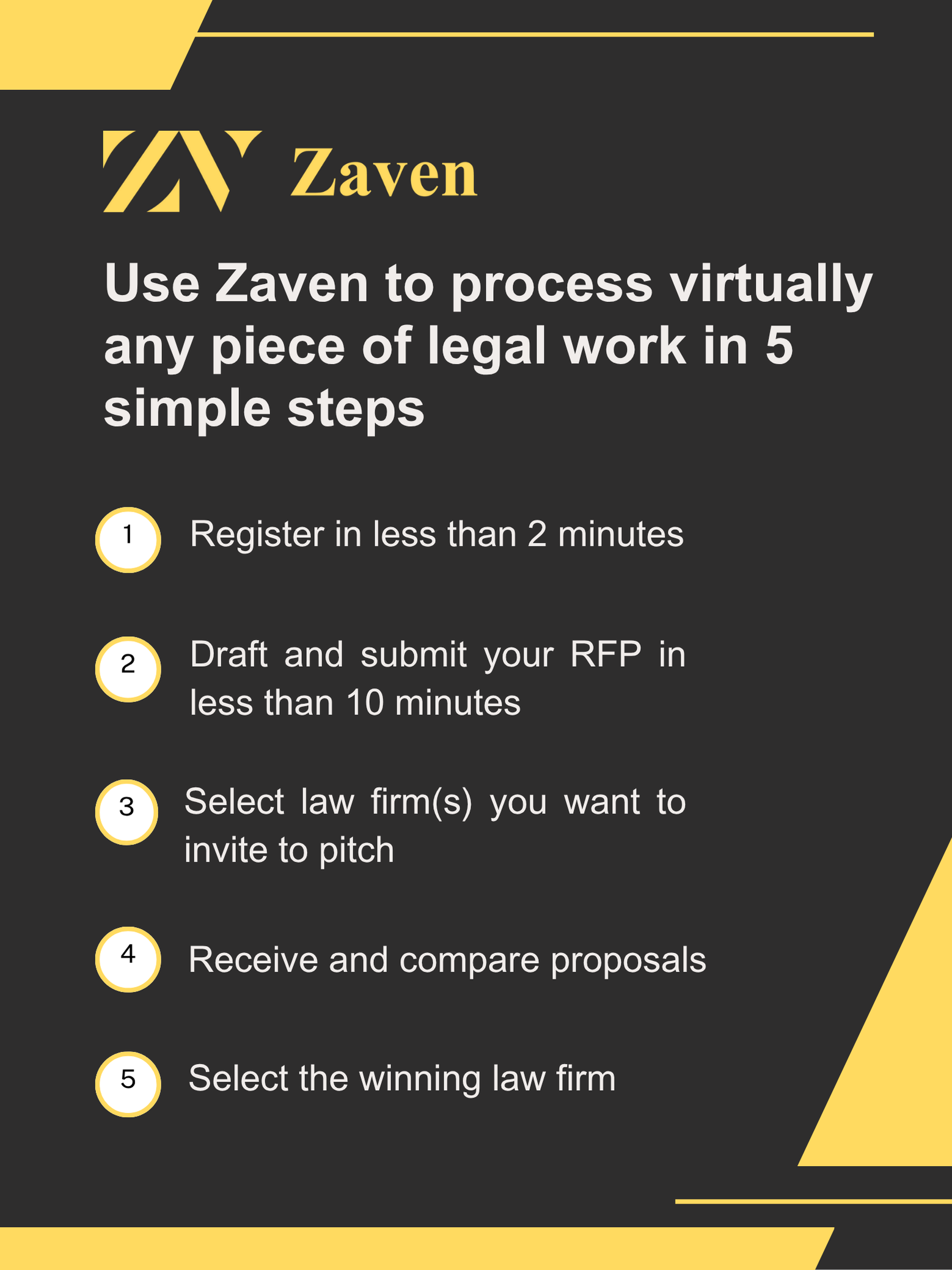
These are exactly the shifts Zaven is designed for. As in-house teams gain strategic weight, as pricing models evolve, and as the market for legal services fragments between traditional firms, AI-native providers, and everything in between, the way you source, compare, and engage legal counsel needs to keep up.
Predictable pricing and healthy competition still deliver the best outcomes. We’re here to make that easier.
“It is not the strongest of the species that survives, nor the most intelligent, but the one most responsive to change.” – Charles Darwin